

2025-01-22 | General
Happy Lunar New Year
Dear Valued Customers, Please note that our office will be closed for the Lunar New Year holiday from January 25th to February 2nd. During this time, responses
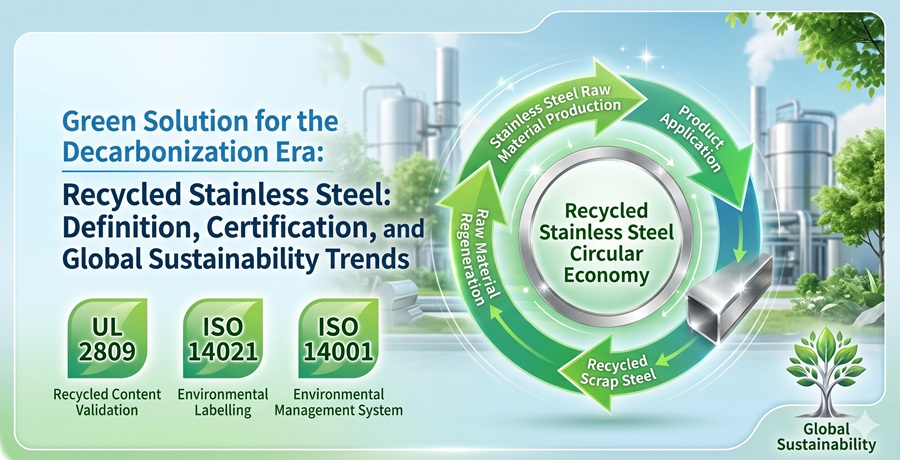
With global climate change and the implementation of carbon reduction regulations, the stainless steel industry is undergoing a profound green revolution. Recycled steel has evolved from an environmental concept into a rigid requirement for international supply chain procurement. Drawing on data from world stainless and the latest European and American carbon border policies, this article explores the definition, certification thresholds, primary grades, and driving forces behind recycled stainless steel, along with its practical advantages and disadvantages for the planet.
Recycled stainless steel refers to steel produced primarily using stainless steel scrap as raw material, remelted through processes like the Electric Arc Furnace (EAF). This contrasts sharply with traditional Blast Furnace (BF/BOF) routes that rely heavily on virgin materials like iron ore, nickel, and chromium.
There is no single statutory rule stating that steel with less than a certain percentage cannot be called "recycled." Instead, the industry relies on component transparency and certified percentages.
The policy locomotive driving recycled steel and low-carbon stainless steel is undoubtedly the European Union (EU).
The greatest advantage of stainless steel is its Infinite Recyclability. No matter how many times it is remelted, its physical and chemical properties do not downgrade. Therefore, all common grades on the market are available in high-recycled configurations.
When verifying recycled steel, global buyers generally look at the following Chain of Custody (CoC) certifications rather than the steel grade itself:
Issued by Underwriters Laboratories (UL), UL 2809 is currently the most widely recognized certificate in the electronics and technology industries (such as the supply chains of Apple, Dell, etc.).
ISO 14021 is a globally applicable "scientific standard for definition and calculation." It strictly divides recycled content into two major sources, which is crucial for international buyers' carbon footprint calculations. The ISO 14021 standard defines the calculation methods for pre-consumer and post-consumer recycled material:
International third-party certification bodies such as SGS (Switzerland) and TÜV (Rheinland/Nord/Süd, Germany) focus their verification scopes more on "system integration and regulatory compliance." They conduct independent third-party audits of a steel mill's overall carbon footprint and green material traceability.
The following is a comprehensive summary of the advantages and disadvantages of recycled steel for the planet and the industry, compiled by the Sun Chun Stainless Technical Team based on data from the World Stainless Association:
|
Evaluation Dimension |
Advantages / Pros |
Disadvantages / Cons |
|
Energy & Environment |
Significant Carbon Reduction: Utilizing scrap steel melted in an Electric Arc Furnace (EAF) reduces the carbon footprint by approximately 60% to 70% of CO2 emissions compared to traditional blast furnaces smelting virgin ores. Conservation of Natural Resources: Mitigates the aggressive mining of non-renewable minerals like nickel and chromium, reducing ecological degradation on the earth's surface. |
High Dependence on Power Grid Structure: EAF melting processes rely heavily on electric power. If a country or region's power grid structure is still dominated by coal-fired generation, the actual decarbonization efficiency will be compromised. It must be paired with renewable energy (Green Power) to achieve true zero-carbon steel production. |
|
Supply Chain & Quality |
Zero Degradation in Quality (No Downgrade): Stainless steel possesses 100% infinite recyclability. Its corrosion resistance, mechanical strength, and metallurgical integrity are completely identical to steel manufactured from brand-new virgin ores. |
Extremely Difficult Control of Tramp Element Tolerances: Scrap metal streams are highly complex and frequently mixed with trace impurities (such as Copper [Cu], Tin [Sn], etc.). Steel mills must possess advanced metallurgical refining techniques; otherwise, spiked tramp elements will easily induce micro-cracking during deep forming or alter surface consistency during precision polishing (such as No.4 or Hairline finishes). |
|
Economic Cost |
Compliance with International Carbon Tariffs: Shields enterprises from punitive EU CBAM carbon taxation, securing qualification entry tickets into the green procurement chains of global giants (such as Apple and Schindler). |
Certification & Sourcing Premiums: Due to the operational costs of rigorous tracing systems, intensive scrap sorting, and third-party audits, the current sourcing cost of high-ratio certified recycled steel remains significantly higher than commercial lots. |
At Sun Chun Stainless Co., Ltd., we eliminate compliance and quality volatility for overseas buyers. Operating under verified ISO 9001:2015 and ISO 14001:2015 frameworks, we source only prime-certified materials from major primary producers like YUSCO.
Our internal tracing protocols guarantee that when your high-recycled lots enter our specialized production lines—including our 5 FEET FULLY OIL PROCESS POLISHING LINE, 5 FEET SLITTING LINE, and precision FLY-SHEAR CUT-TO-LENGTH LINES—they maintain an unbroken, verifiable identity chain. Partner with Sun Chun to secure a robust, audit-ready green supply chain.
